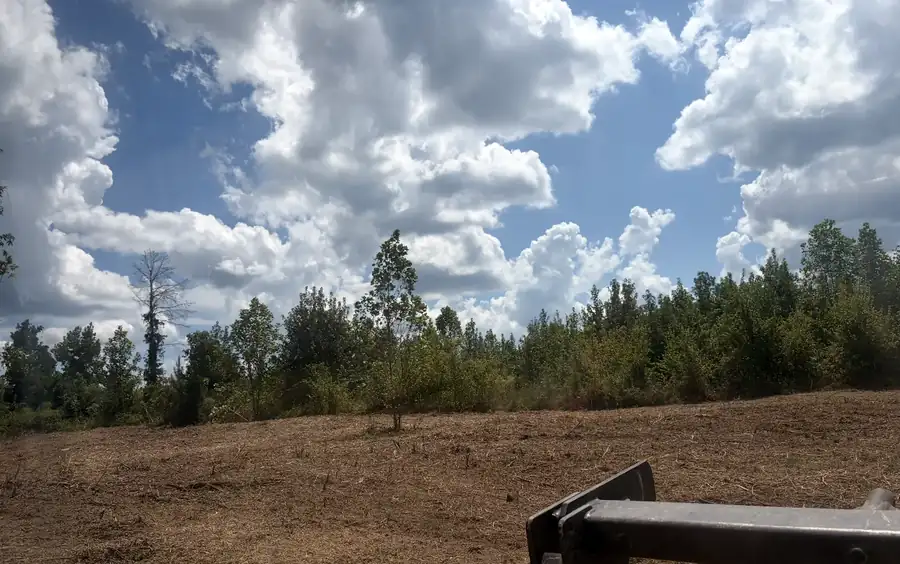
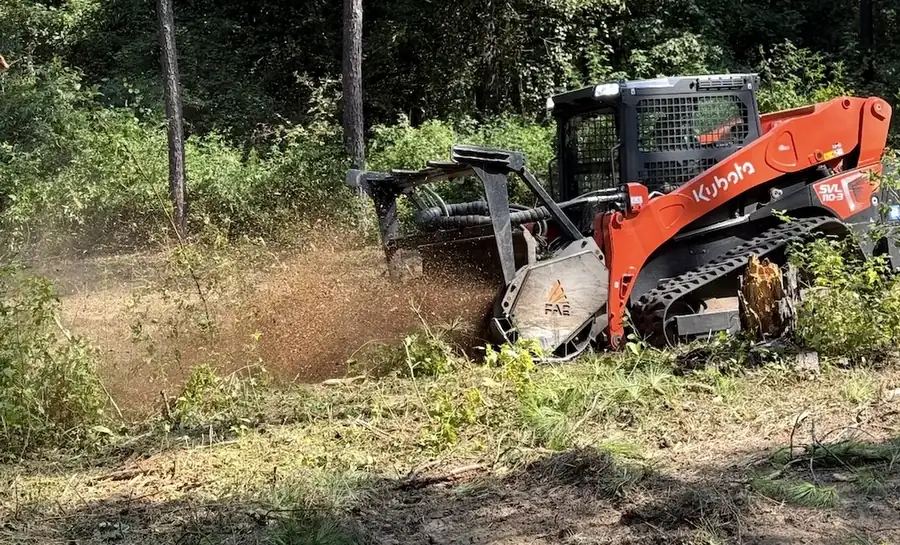
Forestry mulching clears brush and small trees in one pass with one machine, leaves no piles to burn or haul, and keeps the topsoil and roots in place. Its limits are that the stumps stay in the ground, big timber is past what the head will take, and hardy brush like privet and sweetgum sprouts back without follow-up.
Pro: one machine and nothing to haul
A traditional clearing job is a string of jobs: push the trees, rake the roots, pile the debris, burn it or load it, then grade what is left. Mulching skips most of that. One tracked loader grinds the growth where it stands and the chips stay on the ground. There is no burn pile to wait on, no burn permit to plan around and no trucks hauling brush down your drive. On the right ground that makes it the less costly method by a wide margin, and it is why the job is over sooner.
Pro: the dirt stays covered
A dozer scrapes. However careful the operator is, clearing with a blade moves topsoil and leaves bare dirt, and bare red clay on a slope washes with the first hard rain. A mulcher never breaks the ground. The roots stay in to hold the soil and the chip mat sheds water. On hillsides, creek banks and lake lot slopes that is the difference between a clean job and a gully. On old pasture it means the topsoil you want grass in is still there when the brush is gone.
Pro: you choose what stays
Mulching is selective. The machine works around the white oaks you want for shade, the pines you plan to sell later and the dogwoods along the drive. It can take the junk out from under standing timber and leave a stand you can walk through and see across. A dozer can clear around a tree too, but it works on the roots as well as the stems, and roots do not like being run over or cut. If the plan is to keep trees, mulching is the gentler tool.
Con: the stumps stay in the ground
The head can grind a stump flush and a little below, but the root ball stays. That rules mulching out for anything that gets a foundation, a slab, a pond or a plow. Roots under a pad rot and the fill settles. A disc finds every stump in a food plot the first time across. If that is the plan for the ground, the stumps have to be pulled, and that is stump removal or a full land clearing job with the dozer and excavator.
Con: it has a size limit
Our mulchers handle standing hardwood up to roughly six to eight inches on the stump. Bigger trees can be worked around and left, or taken down another way, but a mulcher is the wrong machine for a stand of grown timber. Stem size also drives the time. An acre of briars and two-inch saplings goes quickly. An acre of six-inch hardwood is slow, hard on teeth and priced to match. Good news hides in that limit: the trees too big to mulch are often the ones worth keeping.
Con: brush grows back
Mulching cuts. It does not kill. Privet, sweetgum, kudzu and briars come back from the roots, and in this part of Alabama they do it fast. One pass is a reset. Keeping the ground open takes follow-up: mowing, grazing, a second mulching pass in a year or two, or a treatment plan from your county Extension office. Anybody promising a permanent kill in one visit is guessing. A cleared field that is then mowed or grazed stays open. One that is walked away from goes back.
Con: chips are not a seedbed
A thick chip mat is good at stopping things from sprouting, and that includes grass seed. Where the growth was light the mat is thin and seed finds dirt. Where a privet thicket stood it can be deep enough to slow a planting until it settles. If the goal is pasture or a food plot, say so before the work starts so the passes can be planned for it. Ground that will be disced or plowed is a different job from ground that only needs opening up.
How to weigh it for your land
Start with the end use. If nothing gets built, dug or plowed, and the growth is brush and small trees, the pros win easily. If the ground gets a house, a shop or a pond, clear it. Many properties are both, and one visit can handle the pad with the dozer and the rest with the mulcher. See the full forestry mulching page for what the work covers, and the mulching cost guide for what moves the price.
Common Questions
Is forestry mulching bad for the soil or the trees left standing?
It is one of the lighter ways to clear. The tracks spread the machine's weight, the ground is never scraped and the roots stay in to hold the dirt. Trees you keep stay standing with their bark on when the operator works at a careful pace. The chip mat covers the soil while it rots down.
What is the biggest downside of forestry mulching?
The stumps stay in the ground. For trails, lanes, fence lines, views and pasture that does not matter. For a house pad, a pond, a driveway bed or a field you will plow, it does, and those need the stumps pulled and the ground graded. The second downside is regrowth, which takes follow-up to hold back.
Will mulched land turn back into a thicket?
If it is left alone, yes. Land goes back fast here. Sweetgum, privet and briars sprout from the roots within a season. Mowing, grazing or a second pass a year or two later keeps it open, and that second pass is far quicker than the first because the stems are small.
What to Do Next
Not sure which side of the line your property falls on? Call or text (205) 535-6376 and tell us what the land is for. We will say plainly whether mulching fits, and if clearing is the right answer we do that too.
See our forestry mulching page or call or text (205) 535-6376.