
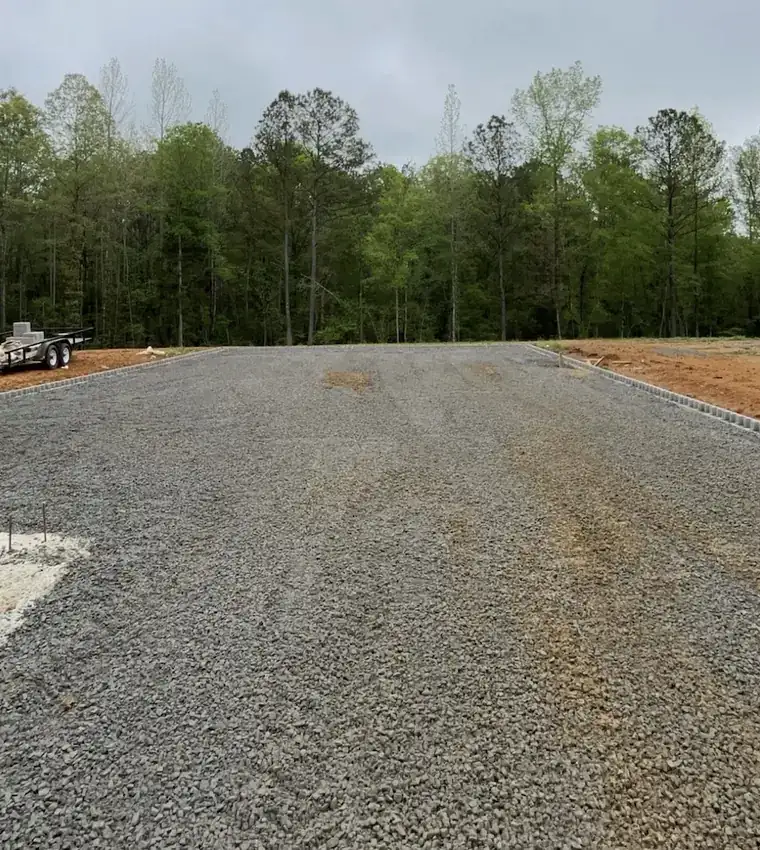
Gravel driveway cost in Alabama is set by the length and width of the drive, what has to be cleared off the route, how firm the ground under it is, how many culverts and how much ditching it needs, and the kind, depth and haul distance of the rock. Down South Land Solutions gives a free estimate after walking the route.
You are paying for drainage, not just rock
Every gravel drive that fails, fails the same way: water got on it and had nowhere to go. It runs down the wheel tracks, takes the fines with it and leaves a washboard and a gully. So the price of a drive that lasts is mostly the price of handling water. Crown in the middle so rain sheds to the sides. Ditches to carry it away. Culverts wherever it has to cross. A base course under the surface gravel so the top layer is not doing structural work. A quote that is only rock spread on dirt will be lower, and you will buy that rock again. See driveways and access roads.
Length, width and the route
Length is the obvious one: twice the drive is close to twice the rock and twice the grading. Width matters as much. A drive that only ever sees a pickup can be narrower than one that has to carry a concrete truck or a mobile home on a trailer. Turnarounds, a parking area by the house and pull-offs on a long single lane all add area. The route itself moves the number too. The shortest line is not always the cheapest. A route that follows high ground and drains needs less ditching and fewer pipes than one cut straight through a low spot.
What has to come off the route first
A drive through open pasture starts with stripping the sod and topsoil. A drive through woods starts with clearing. Trees are pushed, stumps and root balls come out with the root rake and the excavator, and the holes are filled, because a stump left under a drive rots and the gravel sinks into it. That clearing is part of the driveway price on a wooded lot, and on some lots it is the larger part. Brush on the shoulders can be mulched, which is quicker. Tell us what is growing along the route and how thick it is, or send photos looking down the line.
The ground under it
Rock only holds up if what is under it holds up. Firm, well-drained ground needs less base. Soft clay, a wet draw or bottom land that stays damp needs more, and sometimes the soft material has to be dug out and replaced before any rock goes down. Slope adds work as well. A drive climbing a hill needs the water turned off it at intervals before it picks up speed, and a drive cut across a hillside is part cut and part fill, with the fill side compacted in lifts. The time of year matters. Building on saturated ground is slower, and it shows in the price.
Culverts and ditches
Wherever water has to cross the drive, a culvert goes in: at the road ditch, at a draw, at the low spot that holds water after a storm. Each pipe is material plus excavator time to set it, bed it, backfill it and cover it. The pipe has to be sized for the water above it, and bigger pipe costs more. A long drive across rolling ground may need several. Ditches both sides add grading time, and they are what keeps the rock on the drive. See culvert installation. Count the wet spots along your route before you call. That count is a fair first guess at the pipes.
The rock: kind, depth and haul
A built drive is usually a crusher run base with a surface layer over it. The price of rock has three parts: the material at the quarry, how thick it goes down, and how far it rides on a truck. Haul distance is the part people overlook, and on a rural lot it can rival the rock itself. Gravel can come with the job, or you can have it delivered and we place and grade it. Having it dumped on site ahead of us is often cheaper for you. Ask each quote how many tons it allows and how thick the base and the top layer are, so you can compare the same drive.
The entrance at the road
Where the drive meets a public road is its own small job. It needs a pipe under it if there is a road ditch, a firm apron so tires do not break the edge of the pavement, and enough width to turn in. It may also need permission. ALDOT's Access Management Manual says a permit is required for a turnout onto a state highway, so start with ALDOT's permits page. For a county road, ask the county engineer's office what it requires at the road. Inside a city, ask City Hall. Ask early, because the answer can set the pipe size and where the entrance goes.
Comparing quotes, and what to have ready
Ask each contractor: is clearing in the price? How many culverts, and what size? Is there a base course, and how thick? How many tons of rock? Is the drive crowned and ditched? Who deals with the road entrance? If the drive you have now is rutting, a rebuild may not be needed at all. See gravel driveway repair and regrading. For our estimate, have the county, the length of the route in feet or paces, what it has to carry, what is growing on it, the wet spots, and which road it meets. Then we walk it and price it, free.
Common Questions
How much does it cost to gravel a driveway?
It depends on the length and width, what has to be cleared, how firm the ground is, how many culverts and how much ditching it needs, and the tons of rock and how far they are hauled. A short drive across firm pasture and a long one through wet woods are different jobs. Our estimate is free after walking the route.
Is it cheaper to have gravel delivered myself for a new driveway?
Often, yes. Gravel can come with the job, or you can order it from the quarry and have it dumped on site ahead of us, and we place and grade it. Ask us for the tonnage and the kind of rock first, so the right material arrives in the right amount.
How much gravel does a new driveway need?
It comes from the length, the width and the depth of the base and the surface layer, and soft ground needs more base than firm ground. Quarries sell rock by the ton, so the route has to be measured before the tonnage can be figured. We work that out when we walk the drive.
Want a Number for Your Ground?
Pace off the route, count the wet spots and note which road the drive meets. Then call or text (205) 535-6376 with the county and what the drive has to carry. We will walk it and give you a free estimate for a drive that sheds water.
A guide can only show what moves the price. The number for your job comes from a look at your property, and estimates are free.
See our driveways page or call or text (205) 535-6376.