Forestry mulching is a way of clearing land in which one tracked machine with a spinning, toothed drum grinds standing brush, vines and small trees into chips and leaves them on the ground as a mat. Nothing is piled, burned or hauled, and the roots and topsoil stay where they are.
How a mulching head works
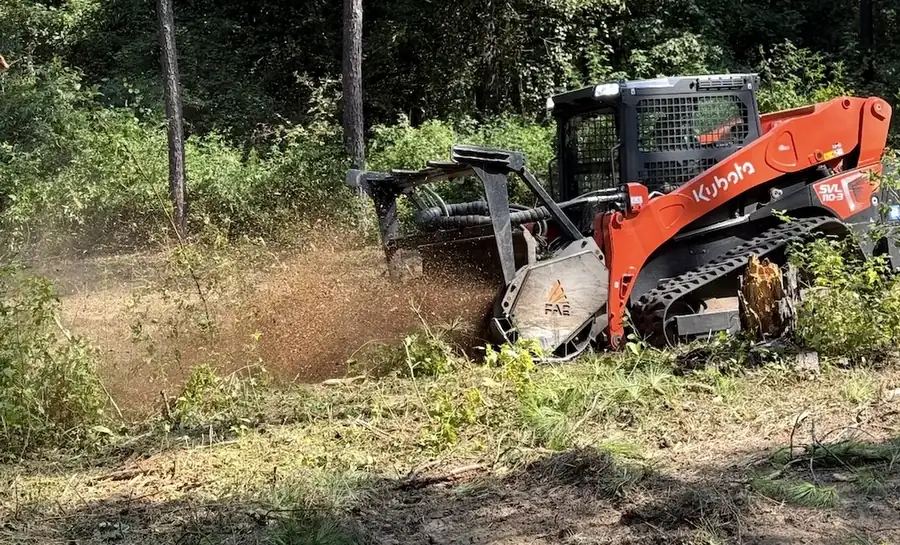
A mulching head is a steel drum with carbide teeth that spins fast enough to grind standing growth where it stands. The machine drives into the brush, lays a stem over, chews it from the top down and then works back across the pieces until they are chips. We mulch with two tracked loaders: a Cat compact track loader with a drum head, and a Kubota SVL110-3 paired with an FAE head. Tracks spread the weight, so the machines cross soft ground and finished areas without cutting ruts. One machine, one pass, and the debris never leaves the spot it grew on.
What a mulcher will grind
Briars, privet, kudzu, sweetgum whips, pine saplings, honeysuckle, greenbrier and standing hardwood up to roughly six to eight inches on the stump. That is the working range on our machines. Stems near the top of that range take several times as long as two-inch saplings, which is why a thick stand of bigger wood is slower than an acre of briars. Timber past that size is a different job: a dozer pushes it, a root rake combs out the roots and an excavator lifts the big stumps. That is land clearing, and it starts where the mulcher stops.
What is left when the machine pulls off
A floor of chips over undisturbed dirt. The roots are still in the ground holding the soil, the topsoil has not been scraped into a pile, and the mat sheds rain instead of letting it cut gullies. The trees you wanted to keep are still standing with their bark on. You can walk it, ride it and see across it as soon as the machine is done. The chips settle and rot down over the seasons that follow, and they shade out some of the weed seed while they do. There is no burn pile to watch and no windrow left across the back of the property.
What mulching does not change
The stumps. The head can grind a stump flush and a little below, but the root ball stays in the ground. That is fine under a trail and wrong under a slab. Mulching also does not kill what it cuts. Privet, sweetgum and kudzu sprout from the roots, so one pass is a reset, not a cure. A second pass a year or two later is far faster than the first, and our guide to clearing privet, kudzu and underbrush covers what keeps it from coming back.
Jobs where forestry mulching fits
Trails and four-wheeler paths. Fence lines and survey lines that have grown shut. Thinning the understory out of timber you want to keep. Pasture that has gone to sweetgum and briars. Shooting lanes, food plots and firebreaks. Opening a view on a lake lot while the bank stays covered. Cleaning up tops and sprouts behind a logging crew. The common thread is that nothing gets built or dug on the ground afterward, so the stumps can stay, and you want the dirt left covered and not bare.
Jobs where clearing is the better tool
Anything that gets a foundation, a pad, a pond or a plow. Roots left under a slab rot and settle. A disc or a plow finds every stump you left. For a house site, a shop pad, a driveway bed or a field you plan to work, the stumps have to come out and the ground has to be graded, and that takes the dozer and the excavator. Many properties need both: the pad and the drive cleared, the slopes and the back acres mulched. Our comparison of forestry mulching and bulldozing walks through the choice by end use.
What it takes to price a mulching job
Five things: the county the property is in, roughly how many acres or how long and wide the strip is, what is growing on it, whether a truck and trailer can get to it, and any date you are working toward. A few photos help. Estimates are free and are priced off the property after a look, on the ground if you are local or on satellite first if you are not. Small jobs carry a minimum and you hear the figure before you commit. The full scope of our forestry mulching service is on its own page.
Common Questions
Can a forestry mulcher grind stumps?
Down to the ground, yes. The head can grind a stump flush and a little below the surface, but the root ball stays in the dirt. That is the right result for trails, lanes, fence lines and pasture. If stumps have to come out for a pad, a pond or a plowed field, that is a clearing job with the dozer and excavator, and we do that too.
How long do the chips from forestry mulching take to rot down?
It depends on how thick the growth was and how big the stems were. Fine chips from briars and saplings settle and break down over a few seasons. Chunks from stems near the top of the mulcher's range last longer. In the meantime the mat holds the dirt, sheds rain and shades out some weed seed.
Can a forestry mulcher work around trees I want to keep?
Yes. That is one of the main reasons to choose it. The machine takes out the brush and saplings under and between the keepers and leaves the timber standing. Mark the trees you want, or walk the property with us and point them out before the work starts.
What to Do Next
If you have ground that has grown shut, call or text (205) 535-6376 with the county, the acreage and what is growing on it. We will tell you whether it is a mulching job, a clearing job or some of each, and give you a number after a look at the property.
See our forestry mulching page or call or text (205) 535-6376.